2026 Best Green Matcha Powder for Wholesale Buyers?
Choosing the 2026 best Green Matcha Powder for wholesale requires more than comparing bright color and bulk prices. Buyers need evidence from the field, not polished sales language.
Sen no Rikyu, the influential Japanese tea master, is often quoted: “Tea is naught but this: boil the water, then make the tea and drink it.” His simple principle still matters. Quality begins with careful cultivation and continues through processing, testing, and storage. Shade-grown tencha, stone milling, and harvest timing can strongly affect flavor and performance. A vivid emerald color may suggest freshness, but it cannot prove origin or purity.
Wholesale buyers should examine cultivar information, production region, harvest date, milling method, and batch-level testing. Certificates of analysis should address contaminants, microbiological safety, and pesticide residues. Supplier audits also deserve attention. Ask how the powder is packed, stored, and shipped. Oxygen, heat, moisture, and transparent packaging can quietly damage aroma and color. Request samples before committing to pallets. Test them in lattes, bakery recipes, and traditional whisked tea. Real use exposes bitterness quickly.
No buying guide is perfect. Even experienced buyers can overvalue color or undercheck documentation. Price can mislead. A lower quote may hide weaker traceability, while a premium label may offer little practical advantage. This guide compares reliable signals for cafés, beverage manufacturers, retailers, and distributors. It considers taste, consistency, safety documentation, supply capacity, and total purchasing risk. The strongest Green Matcha Powder is not always the brightest sample. It is the product that performs consistently, meets documented standards, and supports honest long-term sourcing.
Define Matcha: Tencha Is Commonly Shade-Grown for 20–30 Days
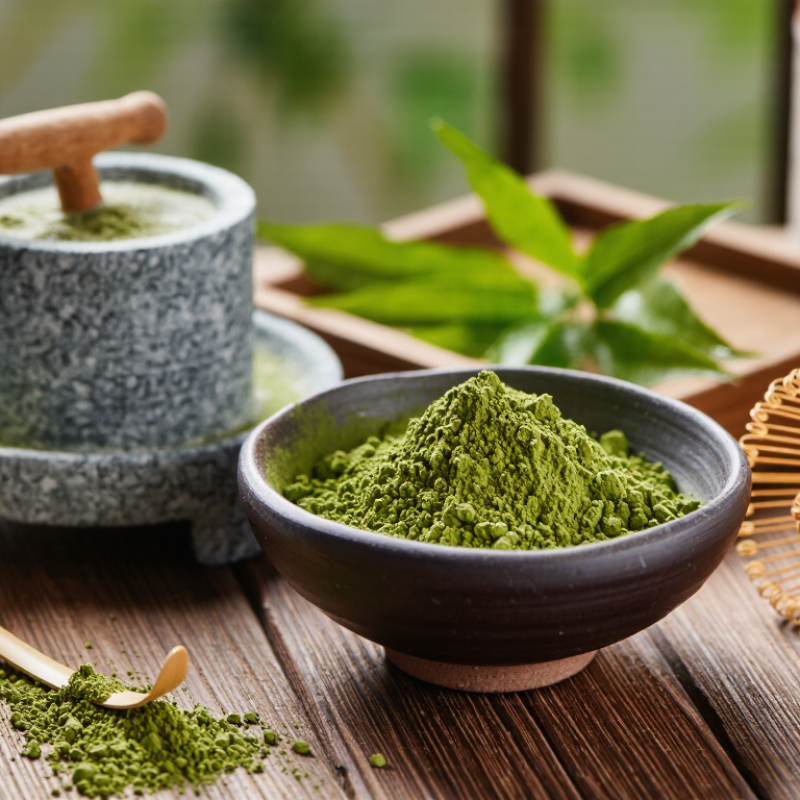
For wholesale buyers, matcha begins with tencha, not ordinary green tea ground into powder. Tencha is commonly shade-grown for 20–30 days before harvest. This reduces direct sunlight and changes the leaf’s chemistry, supporting higher chlorophyll and L-theanine retention. The leaves are steamed, dried without rolling, and carefully deveined before milling.
The shade period needs verification. Ask suppliers for harvest records, shading dates, cultivar information, and production-region documents. Japan’s Ministry of Agriculture, Forestry and Fisheries reported approximately 78,000 tonnes of tea production in 2023, while only a limited portion becomes tencha. This gap matters. A product labeled “matcha” may differ significantly in origin, processing, and sensory quality.
Color is useful, but not enough. A reliable batch should show a vivid green tone, fine texture, clean aroma, and limited bitterness. Laboratory testing should cover moisture, microbiological safety, pesticide residues, and heavy metals. ISO 3720 provides a broader tea framework, but buyers still need matcha-specific specifications. The Japan Tea Export Promotion Council also identifies powdered tea as an expanding export category, yet market growth can encourage loose labeling. Be cautious.
Taste trials expose weaknesses quickly. Mix one gram with warm water, then test it in milk or bakery applications. Some lots look bright but taste thin. Others are less vivid and more balanced. That contradiction deserves attention. Shade-grown tencha is a strong starting point, not automatic proof of premium quality.
Compare Grades: “Ceremonial” Has No Globally Binding Industry Standard
For wholesale buyers, “ceremonial” should be treated as a marketing description, not a regulated grade. No globally binding industry standard defines it. ISO 11287:2011 covers green tea terminology, but it does not establish a ceremonial matcha category. One supplier’s premium powder may be another supplier’s entry grade.
Practical buying starts with measurable evidence. Ask for cultivar, harvest season, shading period, milling method, origin, and batch records. A bright green color can suggest chlorophyll retention, but color alone proves very little. Request a certificate of analysis covering moisture, microbiology, pesticide residues, heavy metals, and foreign matter. Check the testing laboratory and report date. Paperwork matters.
Scale also requires realism. The USDA Foreign Agricultural Service, in its Japan Tea Annual 2024 report, estimated Japan’s 2023 tea production at about 69,800 metric tons. Matcha is only one segment of that output. MAFF statistics also show continuing regional differences in tea production and quality. That makes origin claims worth checking carefully. I would compare ten-gram samples in water, not just inspect sealed bags. Record bitterness, umami, aroma, sediment, and color after ten minutes. My own weak point is relying too heavily on visual brightness. Wholesale decisions need repeatable specifications, not attractive words.
Measure Quality: Matcha Delivers About 19–44 mg Caffeine per Gram
For wholesale buyers, caffeine is a measurable quality indicator, but it is not a complete quality score. Published compositional analyses commonly place matcha caffeine near 19–44 mg per gram. The range is wide. A two-gram serving may therefore provide approximately 38–88 mg of caffeine.
Ask suppliers for batch-specific laboratory results, not catalogue averages. Testing should identify the method, sample weight, moisture basis, and production date. High-performance liquid chromatography, or HPLC, is widely used for caffeine measurement. Moisture can distort comparisons. A wet sample may appear less concentrated than the same powder tested on a dry basis.
The European Food Safety Authority’s Scientific Opinion on Caffeine (2015) considers single doses up to 200 mg safe for healthy adults, with individual variation. That reference helps buyers assess serving guidance, but it does not replace local requirements. Caffeine also changes with cultivar, shading, harvest timing, and milling conditions. I would not treat a higher result as proof of better matcha. That assumption is too simple. Buyers should compare caffeine with color, aroma, particle size, microbial testing, and contaminant screening. A practical purchasing specification might require 19–44 mg/g, verified by an independent laboratory. Still, the range may need adjustment after seasonal testing. Consistency matters more than one impressive number.
2026 Best Green Matcha Powder for Wholesale Buyers
Matcha delivers approximately 19–44 mg of caffeine per gram. Use this natural range as a quality-screening reference when comparing wholesale samples.
The chart shows the reported lower bound, midpoint, and upper bound of the approximate caffeine range. Actual caffeine levels can vary with cultivar, growing conditions, shading, harvest timing, and laboratory method.
Verify JAS Organic Claims: Processed Foods Need ≥95% Organic Ingredients
Wholesale buyers seeking green matcha in 2026 should inspect organic claims before discussing price. Under Japan’s JAS Organic Standard, processed foods generally need at least 95% organic ingredients, excluding permitted items such as water and salt. The percentage alone is not enough. Ask for the current JAS certificate, product name, certified facility, and validity dates. Check whether the certificate covers the exact matcha blend, not only the factory.
Trace each lot from tea field to sealed carton. Request harvest records, milling dates, storage conditions, and transaction documents. A credible supplier should explain how organic and conventional powders remain separated. Look for sealed bags, cleaning logs, and clear lot codes. I would also compare the ingredient declaration with the calculation behind the 95% threshold. Small discrepancies matter. Laboratory tests can assess pesticide residues, heavy metals, and microbes, but they do not replace organic certification. This distinction is often missed.
Packaging claims require careful reading. “Natural,” “clean,” or “green” does not equal JAS organic. Ask for a clear image of the certification mark and confirm it through the relevant certification body. Documents may be incomplete. That is not proof of fraud, but it requires follow-up. I have seen buyers focus on bright color and forget origin evidence. Matcha can look excellent while its paperwork remains weak. Keep approval records, sampling notes, and supplier replies before placing a wholesale order.
Select Wholesale Lots: Audit Origin, Lab Tests, MOQ, Shelf Life, and Traceability
The best green matcha powder for wholesale buyers in 2026 requires more than a bright green sample. Buyers should audit the growing region, harvest season, milling method, and exporter records. Ask for documents connecting the lot number to farms, processors, and shipment dates. Photos help, but they are not proof. Request independent laboratory tests for lead, pesticides, microbes, moisture, and adulteration. Check test dates and methods, not only pass or fail statements. Results should match the exact lot offered.
MOQ can change the real cost of a good powder. Compare pallet pricing with storage capacity, cash flow, and expected sales speed. A low MOQ may reduce waste, while a larger lot may secure consistent color and flavor. Review shelf life at delivery, not only the production date. Freshness matters. Confirm sealed packaging, storage temperature, and remaining months before the best-before date. Traceability should work backward and forward. If a complaint occurs, the supplier must identify affected cartons quickly. That standard sounds strict, but weak records become expensive. I still see buyers trusting aroma alone. That is an imperfect shortcut.
Tips: Keep a receiving checklist with the lot number, seal condition, color, aroma, and document links. Retain a sealed sample for comparison during the contract period. Ask who pays for retesting when results conflict. Do not accept vague claims such as “ceremonial quality” without measurable specifications. Write acceptance limits into the purchase agreement. Small details protect margins.